
RAYPCB · ENGINEERING GUIDE
ITEQ IF-E Flex: Resolve the Exact FCCL Construction
ITEQ IF-E is an incomplete or legacy flex-material callout in the public evidence reviewed for this page. ITEQ's current FCCL page distinguishes IF-2LD and three-layer IF-FD/FS products; it does not establish a direct IF-E equivalence. The interactive requirement register helps recover a usable specification without borrowing unrelated family values.
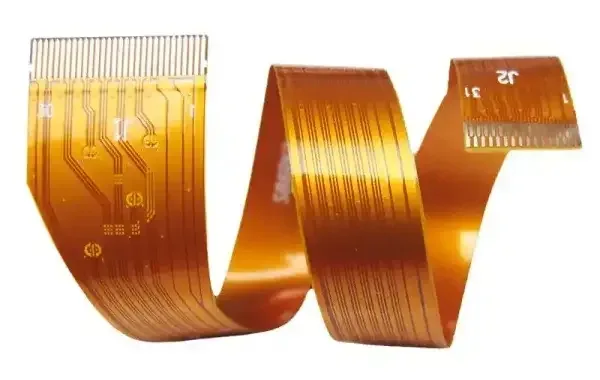
Determine the physical product first
Ask whether the offered material is single-sided or double-sided, adhesive-based or adhesiveless, and which copper and base-film gauges it contains. Request the complete code from the supplier's label or controlled sheet. A generic statement that the product is flexible does not answer those questions, and an abbreviated purchasing description may hide a different construction.
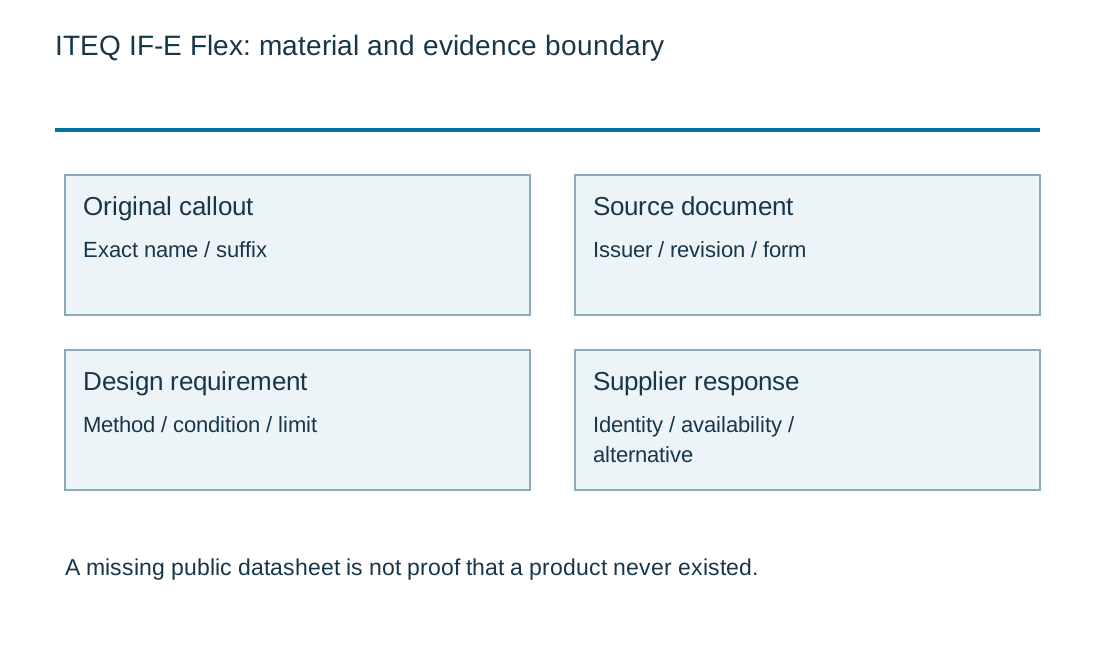
Construction and decision boundaries
| Review item | What this page establishes | What remains project-specific |
|---|---|---|
| Original callout | IF-E as received | Retain source and revision. |
| Current candidates | IF-2LD and IF-FD/FS are separate families | Do not assign an equivalence automatically. |
| Release record | Requirement, status and evidence | Open gaps remain visible. |
Keep current families as candidates
The presence of IF-2LD on an official page is evidence for that family, not proof that every IF-E reference means IF-2LD. Likewise, the existence of an adhesive-based family does not prove which resin system an older order used. Record the proposed mapping and its source, then compare the features controlling this design before approving a change.
| Review item | What to establish |
|---|---|
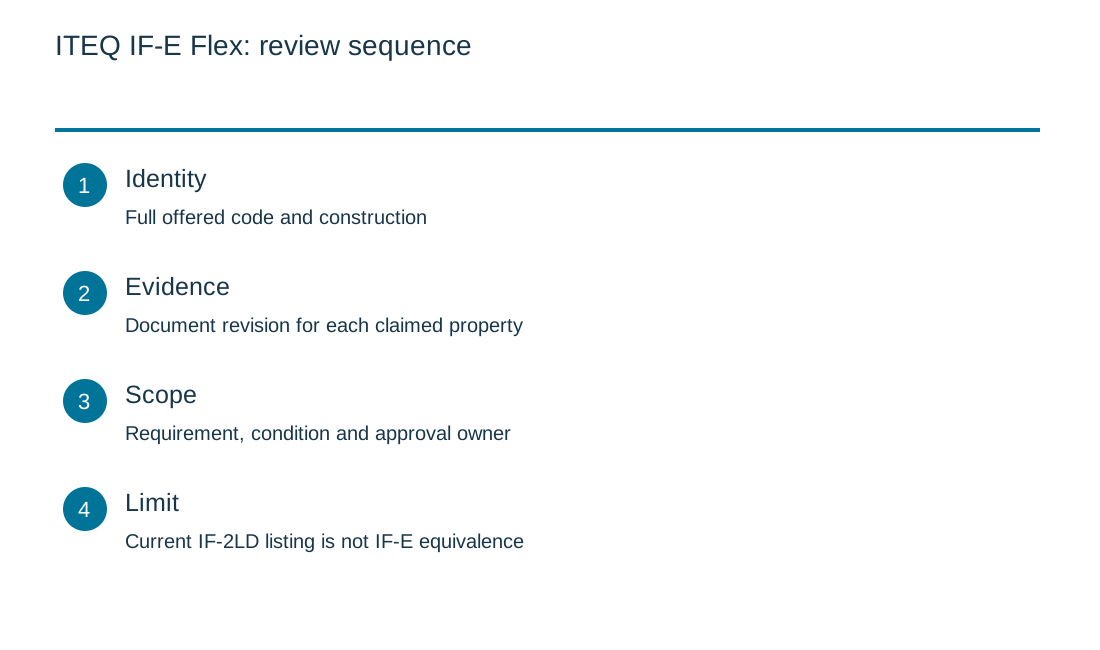
| Identity | Full offered code and construction |
| Evidence | Document revision for each claimed property |
| Scope | Requirement, condition and approval owner |
| Limit | Current IF-2LD listing is not IF-E equivalence |
Build a requirement register
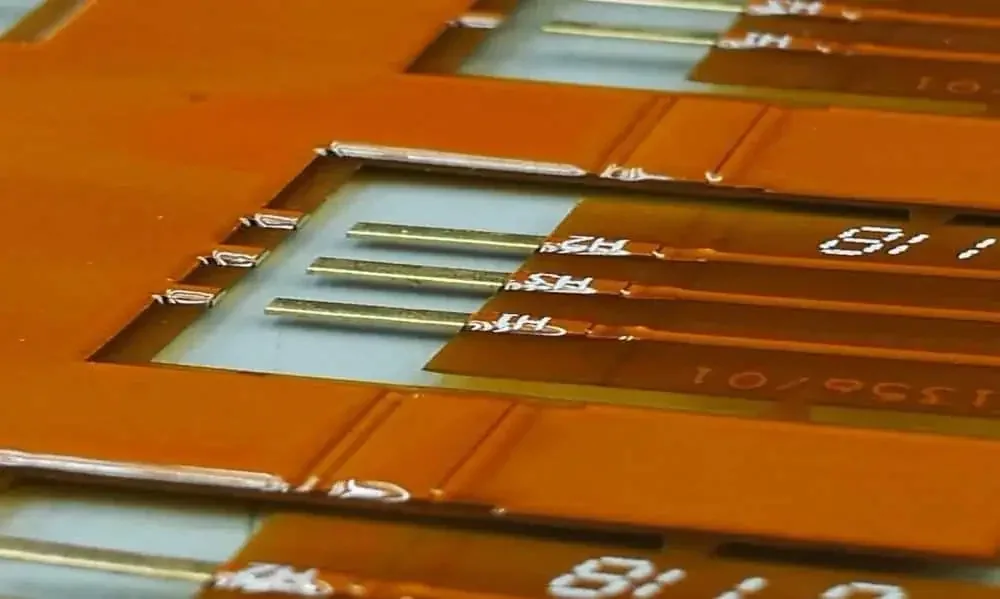
Enter each material or construction requirement with an Open, Recorded or Not applicable status. A recorded item needs a concrete document reference; an exclusion needs a reason. The downloadable worksheet stays local. It is an organized clarification record, not a certificate or an automated approval, and editing an input invalidates the previous result until recalculated.
ITEQ IF-E Flex requirement register
ITEQ IF-E Flex requirement register
Use the current inputs and keep the assumptions
Start with the example only to inspect the units and the calculation boundary. Replace every assumption with a value tied to your own document or measurement. An empty numeric field is not zero. The review-reference field is a local label; avoid entering customer names, confidential part numbers or other private information into a public worksheet.
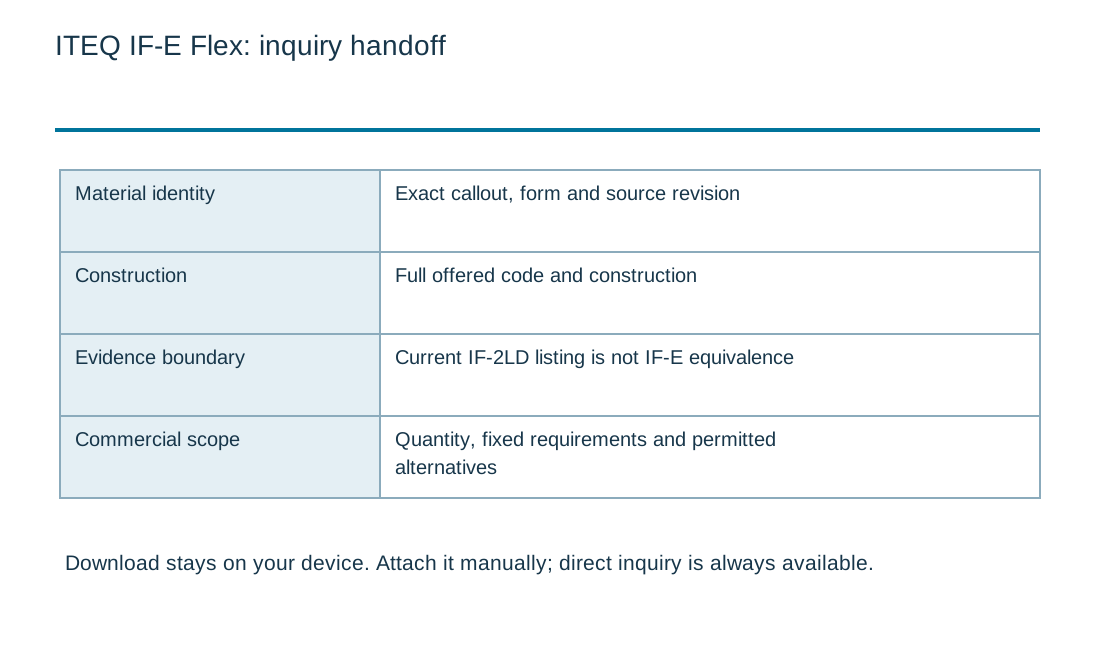
After calculating, read the notes alongside the numerical result. Changing any input invalidates the displayed result and disables its download until you calculate again. For a comparison, keep the units, geometry, material condition and measurement boundary consistent. A long decimal result does not imply equally precise input data. The downloadable record stays on your device and can be attached manually to an inquiry. It is not automatically transferred into the Contact form.
If an input is unknown, identify the person or document needed to resolve it. Do not fill a gap with a favorable generic value simply to obtain a result. You can request a material or fabrication review without using the tool. The arithmetic illustrates a relationship; it does not accept a construction, certify a material, establish current pricing or replace a supplier process specification.
| Input | What to establish before using it |
|---|---|
| Review reference | Nonconfidential revision label. |
| Requirements and evidence · CSV | Status is Open, Recorded or Not applicable. Recorded needs a source reference; exclusions need a reason. |
Optional cost comparison from your own allowances
Use a quotation or a clearly labeled internal assumption for each input. Keep the quantity, construction and inspection scope the same when comparing alternatives. This uncalibrated planning model adds entered values; it contains no current market rates and does not issue a RAYPCB quotation. You can contact the team without completing it.
Optional project allowance comparison
Ask questions that change the design
For a moving circuit, request the full bend section and relevant motion evidence. For a fine-line circuit, ask for finished conductor geometry and registration capability on the proposed stack. For RF use, request method- and frequency-qualified dielectric data. Avoid filling every property cell with a favorable number from a different laminate simply to complete a comparison chart.
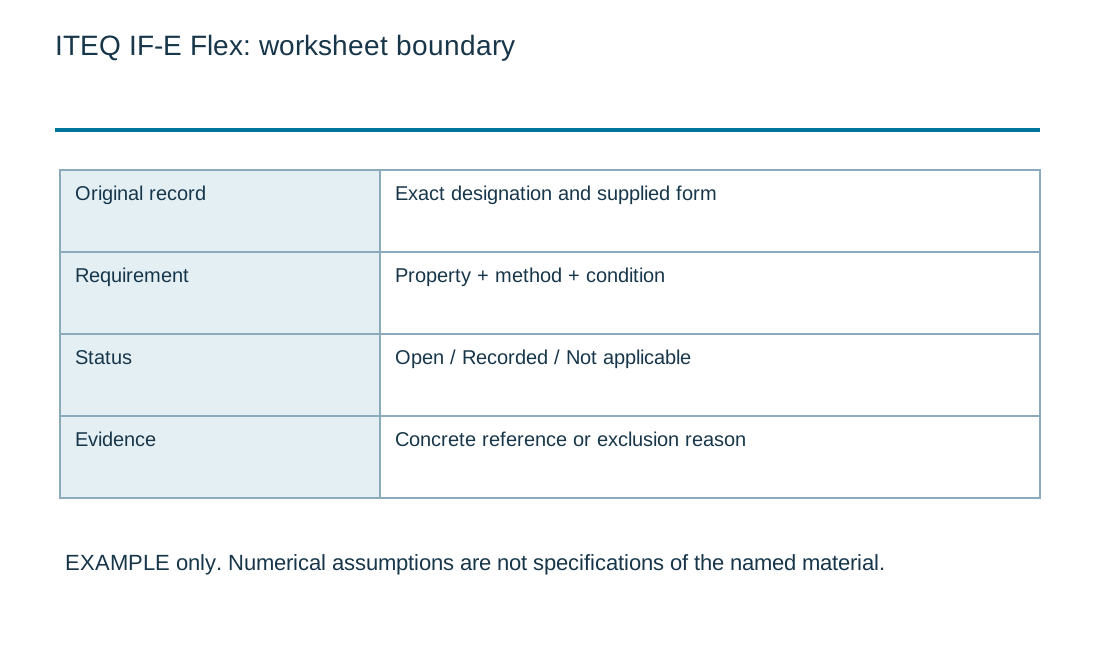
Coordinate protection and bonding
IF-FC coverlay and the IF-BC bonding question have distinct jobs. Confirm that the proposed combination has a reviewed process route. If another historical construction such as SF302 is being considered, compare full material identity and physical layers rather than treating all polyimide products as interchangeable.
Send the evidence gap with the inquiry
Include the original IF-E callout, any previous lot or source reference, required circuit architecture, stack and quantity. Mark allowed alternatives clearly. Ask the supplier to return the exact offered material and the unresolved points. A quotation can support an engineering discussion before every field is known, provided the missing identity is not presented as settled.
Release the material with its finished flex construction
When a legacy callout cannot be matched to an authoritative sheet, preserve the original text and open a clarification item. Ask for the supplier's full code, the document revision and a cross-section. A modern family name that sounds similar is only a candidate. Document the technical comparison and customer approval before replacing a controlled material requirement; do not convert a search result into an equivalence certificate.
Start the release drawing with the shape the circuit will occupy in the product. Show the flat outline, assembled position, motion envelope and regions that must remain flat. Identify installation folds separately from movement during service. A flex that is bent once to clear an enclosure has a different verification problem from a cable that moves on every operating cycle. State the mechanism, travel, speed, temperature and expected duty rather than writing only flexible PCB.
Then define each cross-section that actually exists. The bend span, connector tail, component island and rigid transition may have different copper, coverlay, adhesive and stiffener layers. A single finished-thickness number cannot describe all of them. Indicate the measurement locations and include tolerances where fit or electrical behavior depends on them. Ask the fabrication team to return the proposed construction for approval before it becomes a purchasing assumption.
Copper deserves its own record. Distinguish supplied foil from copper remaining after imaging, etching and plating. Identify which surfaces receive additional metal and whether the bending region is plated. The foil process label alone does not establish fatigue life: thickness, grain direction, surface treatment, pattern shape and mechanical restraint also affect the construction. Do not select a copper variant solely because a comparison table calls it the premium option.
Choose verification coupons to reproduce the critical feature. A flat electrical coupon can check continuity or a specified transmission geometry; it does not reproduce repeated motion around a hinge. A bend specimen needs the relevant stack, trace layout, radius definition, temperature, cycling method and failure criterion. Monitor the failure mechanism of interest and keep the sample count with the result. A successful demonstration is useful evidence, but its scope must remain attached to it.
Review assembly as part of the material decision. Components and connectors impose local mass and force, and the support tooling changes how a flexible panel moves during printing, placement and heating. State component keep-out regions, supported areas and the sequence in which temporary supports are removed. A material thermal test is not the oven profile for the populated assembly. Moisture conditioning and permitted thermal exposure need a product-specific instruction.
For purchasing, separate the recurring board cost from tooling, fixtures and qualification. Compare the same quantity, panel assumptions, copper, surface finish, inspection and delivery format. An inexpensive laminate can become an expensive assembly if it requires extra handling or poor nesting. Conversely, a more elaborate stack should solve a stated need; adding layers or thicker copper without an electrical or mechanical reason can create unnecessary work.
Prepare a concise inquiry package even when some inputs are unknown. Include the schematic or connection requirement where relevant, fabrication data, stack sections, mechanical drawing, quantity and a short list of open decisions. Mark exact-material requirements separately from permitted alternatives. Keep the previous approved revision available for repeat builds. The engineering conversation can start with an incomplete stack, provided the missing items are explicit and no unapproved substitution is presented as settled.
Standards, source context and limits
Use the edition, amendment and material-document revision named in the purchase agreement. A standards title, marketing label or supplier product family does not establish that a particular lot meets a requirement. Public summaries are useful for scope; the controlled specification and applicable test method govern acceptance.
The examples on this page are illustrative engineering scenarios. They are not RAYPCB production records or guaranteed material values. Source links identify the organizations responsible for the referenced information. Confirm applicability to the exact grade, construction and test condition before carrying a number into a drawing or qualification report. For a flex board, distinguish the design requirements in IPC-2223, finished-board qualification and performance in IPC-6013, and the material scopes of IPC-4202, IPC-4203 and IPC-4204. These cover different deliverables; naming them does not certify the material or factory. State the contracted revision and applicable material sheet. Source review date: 3 October 2026. Legacy designation, present availability and an approved replacement are separate questions.
For fabrication scope and the agreed construction requirements, see PCB manufacturing.