
RAYPCB · ENGINEERING GUIDE
Isola FR406N: No-Flow Prepreg and Bondline Design
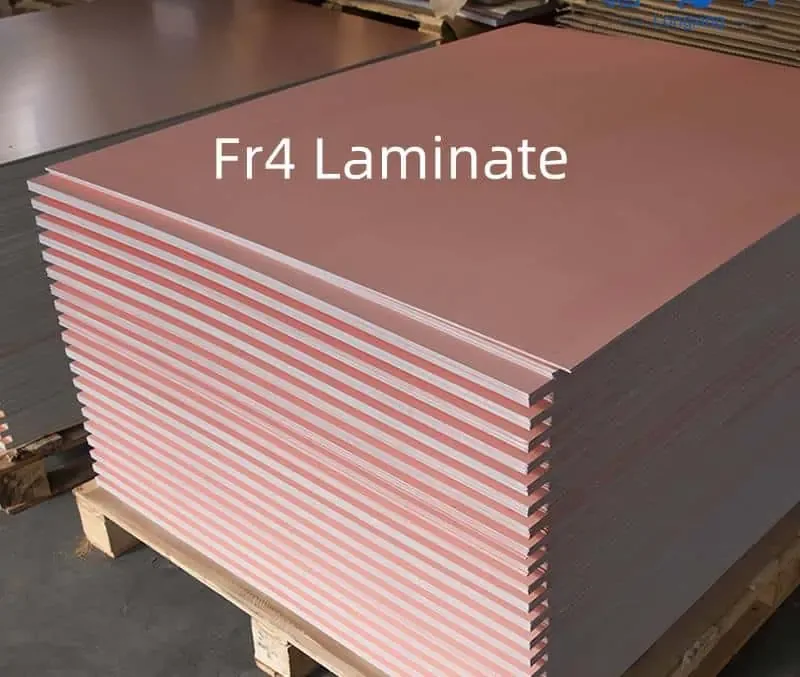
Isola FR406N is a family of no-flow and low-flow specialty prepregs used for bonding where resin movement must be controlled. It is not the same purchasing object as an FR406 copper-clad core. The practical design problem is to fill and bond the intended region while preserving cavities, flex areas and other keep-outs.
This page starts with the bondline. The Isola material overview provides broader context; the questions below help a designer describe the local geometry that a fabricator needs to review.
Specify FR406N by form and flow requirement
The official product page identifies FR406N as a specialty prepreg and gives a typical DSC Tg of 170°C. Its processing guide explains that supplier circle-flow measurements must be correlated with the fabricator's process and actual construction. A no-flow label does not mean zero resin movement under every press cycle.
Record the glass style, resin content, supplied flow range and intended pressed thickness. If the drawing merely says FR406, resolve whether it means a rigid core, conventional flowing prepreg or this controlled-flow bond material before purchase. Do not infer the answer from the final board's thickness.
Evidence and construction decision
| Item | Source or model boundary | Action for the design review |
|---|---|---|
| Form | No-flow and low-flow prepreg | Do not substitute FR406 rigid-core data. |
| Tg | 170°C DSC, typical | Keep source revision with thermal exposure. |
| Thickness units | Public metric/imperial presentation needs clarification | Obtain the controlled supply dimension before release. |
Draw the cavity edge and the bond area
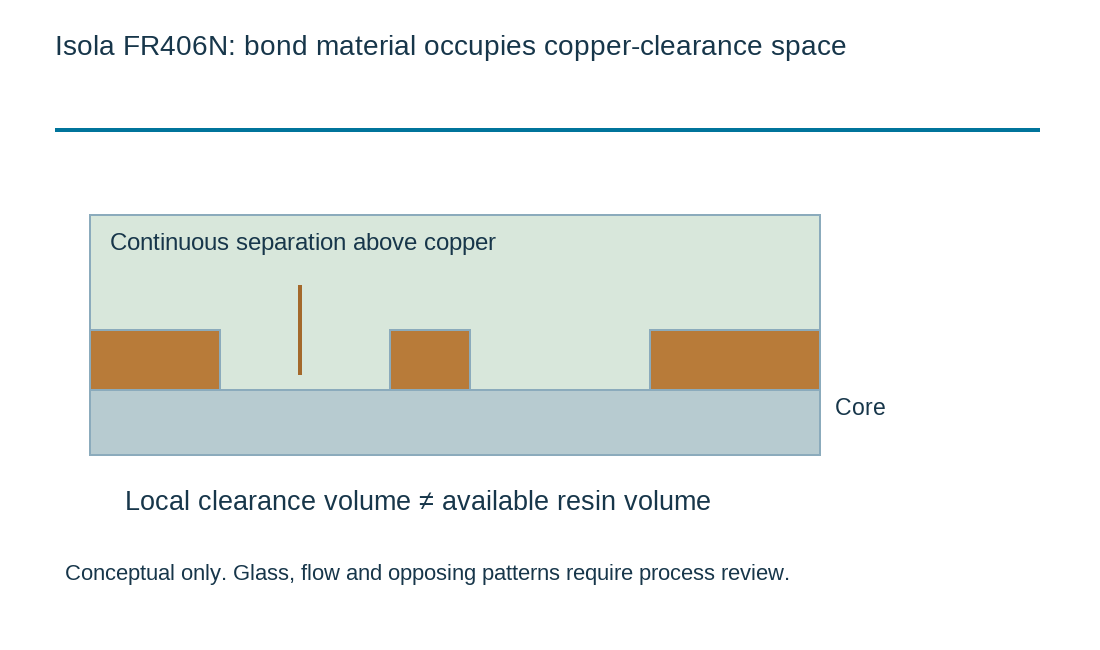
Show the intended resin boundary relative to the flex opening or cavity, including the tolerance that matters after lamination. Identify copper steps and adjacent materials on both faces. A large open field and a narrow strip around an opening can present different filling and pressure conditions on the same panel.
Too little usable flow can leave voids or poor encapsulation; too much can contaminate a required open region. The correct choice is therefore a process window supported by the actual geometry. Compare Arlon 49N only through a reviewed alternative-material proposal, not as a name-for-name replacement.
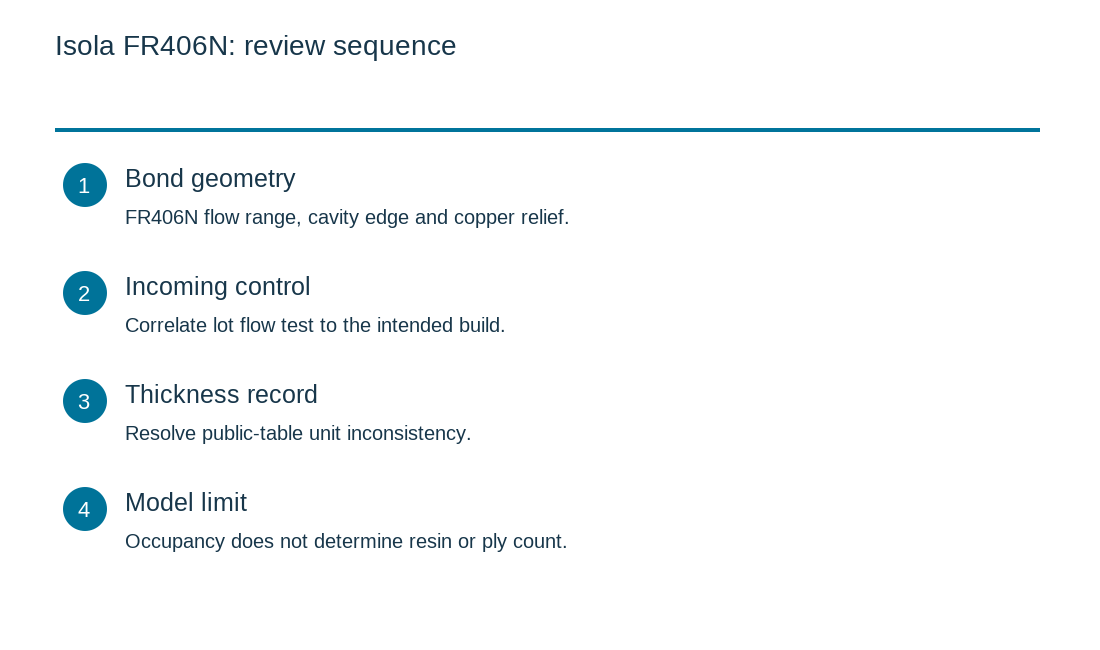
| Review item | What to establish |
|---|---|
| Bond geometry | FR406N flow range, cavity edge and copper relief. |
| Incoming control | Correlate lot flow test to the intended build. |
| Thickness record | Resolve public-table unit inconsistency. |
| Model limit | Occupancy does not determine resin or ply count. |
Copper-clearance volume illustration
Copper-clearance volume illustration
Use the current inputs and keep the assumptions
Start with the example only to inspect the units and the calculation boundary. Replace every assumption with a value tied to your own document or measurement. An empty numeric field is not zero. The review-reference field is a local label; avoid entering customer names, confidential part numbers or other private information into a public worksheet.
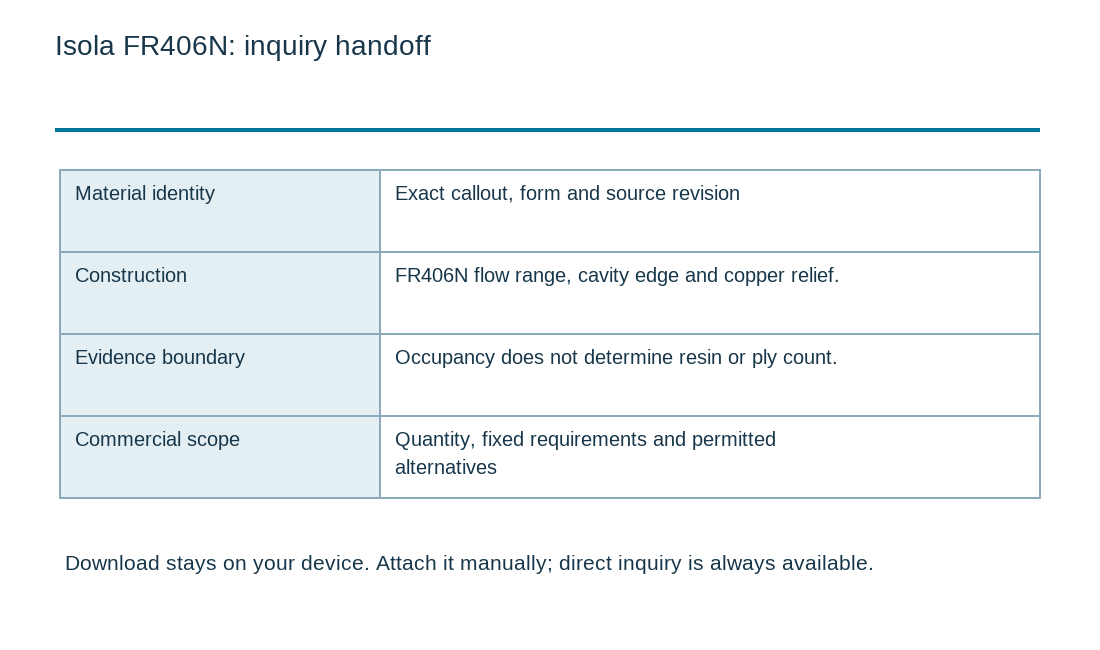
After calculating, read the notes alongside the numerical result. Changing any input invalidates the displayed result and disables its download until you calculate again. For a comparison, keep the units, geometry, material condition and measurement boundary consistent. A long decimal result does not imply equally precise input data. The downloadable record stays on your device and can be attached manually to an inquiry. It is not automatically transferred into the Contact form.
If an input is unknown, identify the person or document needed to resolve it. Do not fill a gap with a favorable generic value simply to obtain a result. You can request a material or fabrication review without using the tool. The arithmetic illustrates a relationship; it does not accept a construction, certify a material, establish current pricing or replace a supplier process specification.
| Input | What to establish before using it |
|---|---|
| Review reference | Nonconfidential revision label. |
| Evaluated bond area · mm² | Panel or coupon area with consistent pattern coverage. |
| Copper feature height · µm | Height of the one patterned surface being evaluated. |
| Retained copper coverage · % | Area fraction occupied by copper on that surface. |
| Final separation above copper · µm | Ideal continuous bondline above the highest copper; excludes roughness and glass. |
Optional cost comparison from your own allowances
Use a quotation or a clearly labeled internal assumption for each input. Keep the quantity, construction and inspection scope the same when comparing alternatives. This uncalibrated planning model adds entered values; it contains no current market rates and does not issue a RAYPCB quotation. You can contact the team without completing it.
Optional project allowance comparison
Interpret thickness and flow measurements carefully
The current public FR406N table has a pressed-thickness tolerance presentation whose metric and imperial figures should be reconciled with the controlled supplier document. Do not copy an internally inconsistent conversion into a production drawing. Ask for the actual lot specification and the relevant test method.
A supplier flow test is useful for incoming consistency, but its fixture and pressure history differ from a finished PCB. Keep the correlation method with the material qualification. A nominal sheet thickness cannot alone establish the remaining electrical insulation above a copper feature.
Use geometric fill volume as a discussion aid
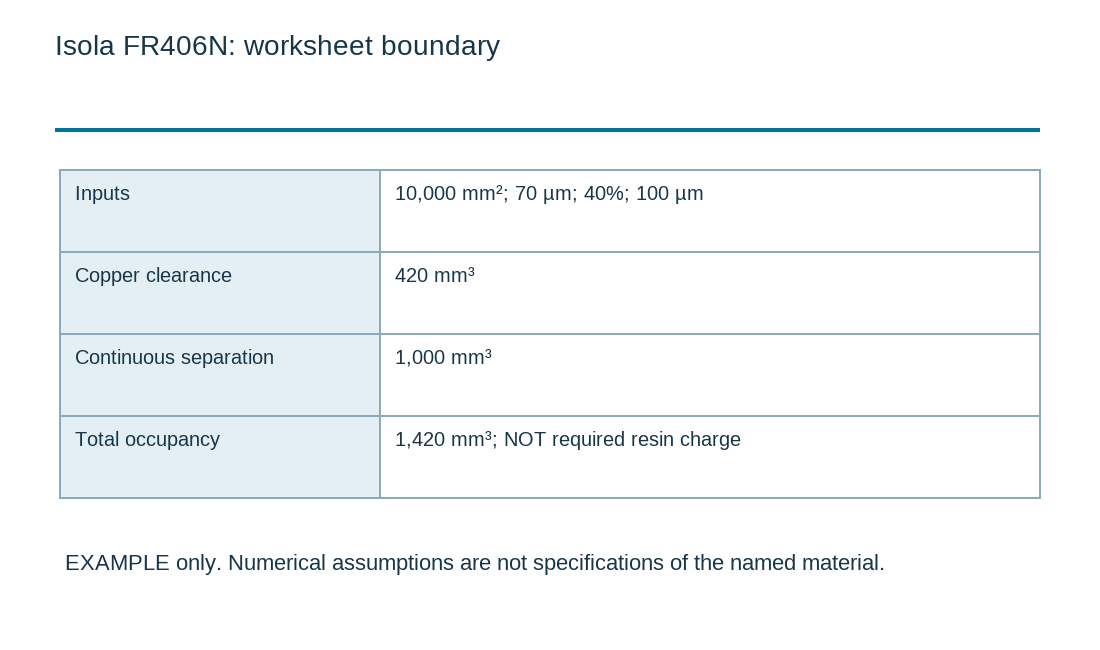
The worksheet separates the clearance volume beside copper from the continuous interval above it. For an assumed area of 10,000 mm², 70 µm copper, 40% coverage and 100 µm separation, the geometric occupancy is 1,420 mm³. This is not a required resin charge or a recommended ply count.
Glass reinforcement, resin already held in the fabric, opposing artwork, squeeze-out and cure shrinkage remain outside that arithmetic. Send the actual copper artwork with any calculation. A single average coverage figure can conceal the largest local clearance, which may be the region that controls the process.
Choose the neighboring page by the real constraint
For a polyimide no-flow request, examine P25N, including its distinct flame-rating and processing context. For a lead-free epoxy bonding review, Arlon 51N provides another material-specific route. These pages own their exact materials; they do not prescribe interchangeable press schedules.
The price discussion should include cutting, tooling, layup complexity, scrap risk and agreed inspection as well as material allowance. Record the quantity and qualification scope. A cheaper sheet is not a saving if the proposed bondline cannot meet the cavity or insulation requirement.
Release a bondline specification, not a generic FR-4 note
An answerable inquiry contains the exact FR406N variant, stackup section, facing surfaces, copper relief, cavity boundary, desired thickness and assembly history. State the required inspection locations and what constitutes unacceptable resin intrusion or voiding.
The fabricator should review handling, incoming flow checks, surface preparation and the press cycle together. Final approval depends on the representative bonded construction and its evidence. The online tool supports preparation of that discussion; it does not certify adhesion, electrical isolation or finished-board reliability.
Review supplied form, local geometry and process together
A stackup is an agreement about physical construction, not just a vertical list of copper layers. Give each dielectric interval an identity and distinguish cured core thickness from the pressed thickness of bonding material. State whether copper is included in every quoted dimension.
Review the implications of a material change across impedance, lamination, drilling, registration and assembly exposure. A replacement with a similar headline Tg or Dk can still require a different geometry or process. Preserve the approved layer order, copper distribution assumptions and measurement basis with the manufacturing files.
Use the worksheet to organize a review, then obtain the fabricator's proposed construction and tolerances. Close differences before release. The final stackup, drawing and procurement material list should reference the same revision, especially when multiple suppliers or repeat orders are involved.
Bonding materials cannot be selected from a cured-laminate table alone. Establish whether the product is woven-glass prepreg, another reinforced bonding system or resin-coated copper. Each form has a different relationship between its supplied condition and the finished dielectric interval. Preserve the exact product and source revision in the proposed build.
Local copper distribution matters. Average coverage can conceal a large clearance region, a thick copper transition or a difficult target area. Supply the actual artwork and identify the locations that drive filling, registration or opening requirements. A single global thickness or aspect ratio does not characterize every local feature.
Process guidance should be applied by the responsible manufacturing team to the actual construction. A public document does not replace press-load qualification, handling controls or an approved drilling and metallization route. Do not use a generic bake or cure instruction for an unidentified bonding material.
Agree how the critical features will be verified. Representative cross-sections, dimensions and appropriate electrical or reliability evidence answer different questions. Keep the selected locations and acceptance requirements with the drawing so that a successful easy region is not mistaken for evidence about the most demanding feature.
Standards, source context and limits
Use the edition, amendment and material-document revision named in the purchase agreement. A standards title, marketing label or supplier product family does not establish that a particular lot meets a requirement. Public summaries are useful for scope; the controlled specification and applicable test method govern acceptance.
The examples on this page are illustrative engineering scenarios. They are not RAYPCB production records or guaranteed material values. Source links identify the organizations responsible for the referenced information. Confirm applicability to the exact grade, construction and test condition before carrying a number into a drawing or qualification report. Sources were reviewed on 3 October 2026. A public catalog search is not proof that an unlisted product never existed. Where the exact designation or current technical sheet could not be verified, this page provides a clarification workflow rather than an invented material specification. Current supply, construction availability and qualification remain separate questions.
For fabrication scope and the agreed construction requirements, see PCB manufacturing.