
RAYPCB · ENGINEERING GUIDE
Solder Mask Removal: Define a Controlled Rework Area Before Choosing a Method
Solder-mask removal exposes an underlying board surface for a defined repair, modification or analysis task. The method must remove the intended coating while preserving copper, laminate and nearby components. A generic instruction to scrape until shiny is not an adequate rework procedure.
This page helps define the removal boundary and evidence needed before work begins. It does not prescribe a solvent, laser setting or abrasive recipe for an unidentified board. If the coating needs restoration afterward, plan the solder-mask repair at the same time.
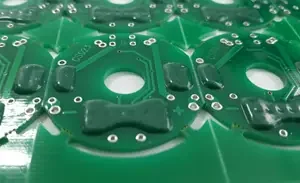
State why the coating must be removed
Exposing a test point, accessing a trace for an approved modification and preparing a defect for analysis are different tasks. They need different boundaries and acceptance evidence. For analysis, removing material can destroy the feature being investigated; preserve the original condition before any intervention.
For functional rework, identify the electrical net, copper geometry and nearby clearance constraints. A small visible patch may sit above a narrow conductor or close to another net. The operator needs a controlled drawing or instruction that defines what may be exposed and what must remain protected.
Identify the material stack
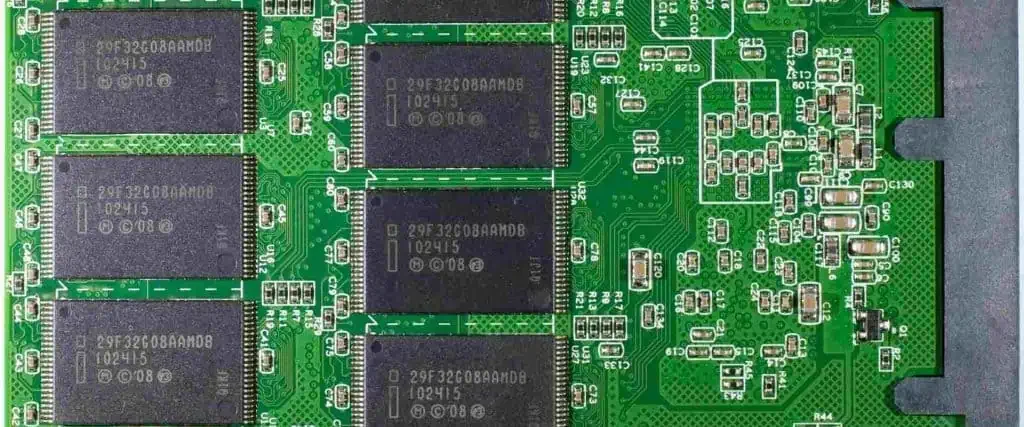
Confirm the board construction, coating type where known, surface finish and populated state. A method appropriate for one coating can attack a different polymer, component marking or adhesive. Unknown material identity is a reason to obtain more information or run a controlled evaluation on a suitable sample.
Mask removal is not necessarily copper cleaning. The surface exposed after removal may still need a separately defined preparation before soldering or coating. Keep those operations distinct so the removal step is not repeated aggressively in an attempt to achieve an unrelated cosmetic appearance.
| Review item | What to establish |
|---|---|
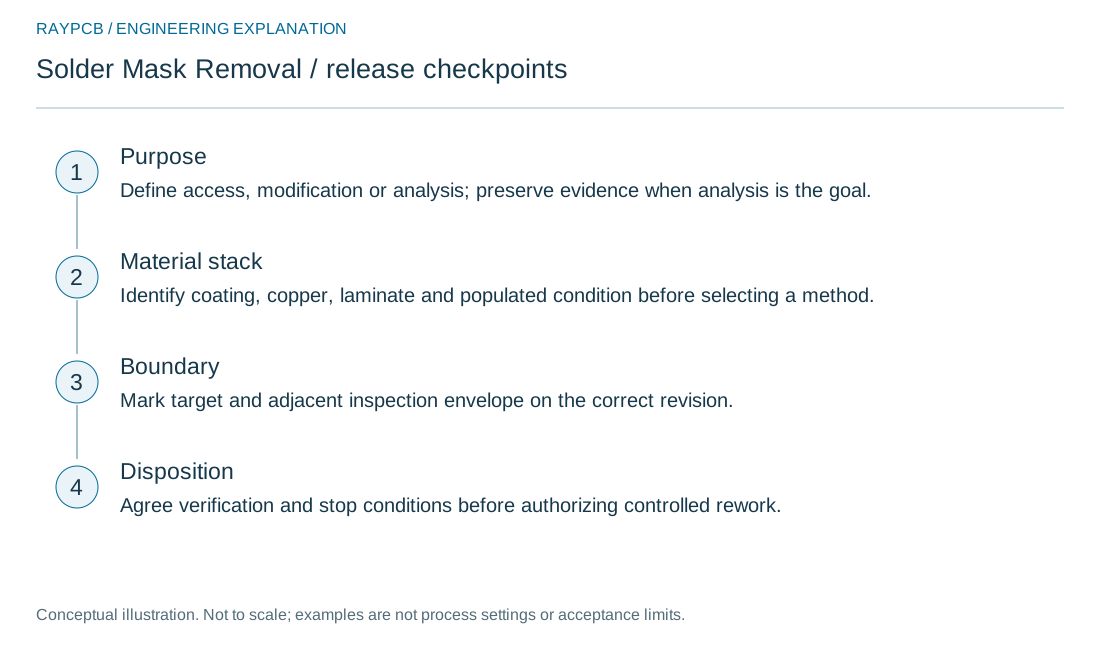
| Purpose | Define access, modification or analysis; preserve evidence when analysis is the goal. |
| Material stack | Identify coating, copper, laminate and populated condition before selecting a method. |
| Boundary | Mark target and adjacent inspection envelope on the correct revision. |
| Disposition | Agree verification and stop conditions before authorizing controlled rework. |
Compare method families by their control needs
Mechanical methods require control of tool geometry, force and debris. Chemical approaches require verified compatibility, exposure control and residue management under the applicable procedure and safety information. Laser or other specialized methods require a qualified process for the material stack and intended removal depth.
None of these labels is a universal best choice. The decision should account for feature scale, access, component sensitivity and available verification. Online demonstrations can show a technique but cannot establish that it is suitable for a different assembly. Use the method supported by the responsible rework process owner.
Reserve a boundary and inspect the neighboring features
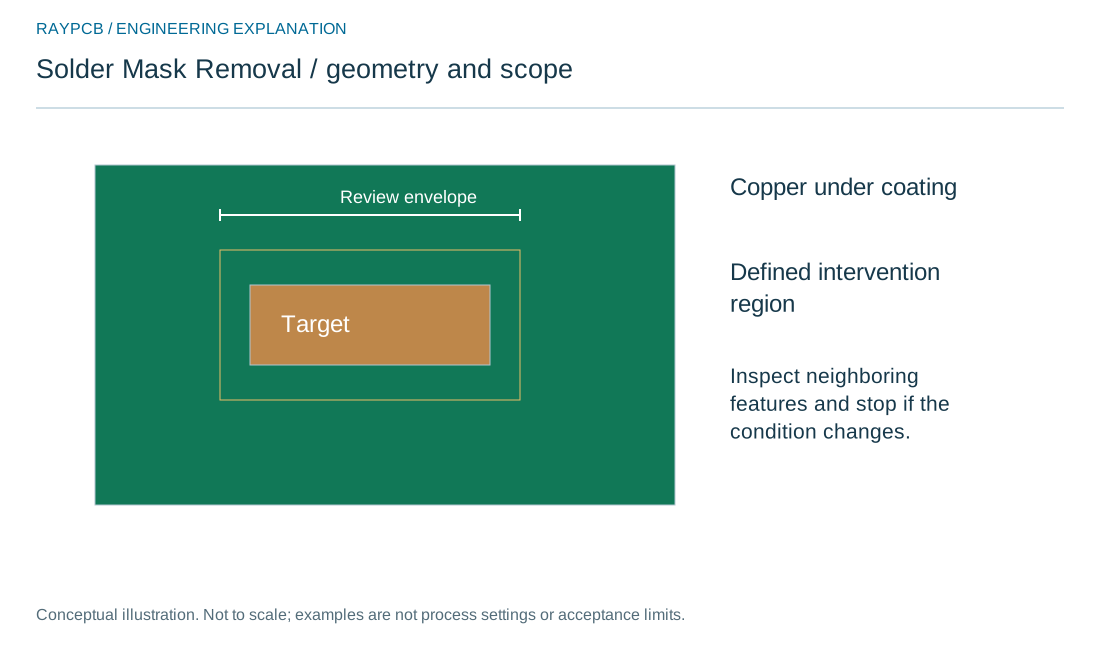
The worksheet records a rectangular removal region and an entered surrounding inspection margin. It reports the ideal target area and the larger review envelope. The margin is an instruction to inspect the surroundings, not a calculated safe distance or a heat-affected-zone prediction.
Mark nearby lands, traces, vias and components that could be affected by tool movement or debris. Include access from the intended working direction. A region that looks clear in plan view may be inaccessible once a connector or shield is installed. Resolve that access problem before authorizing work on a valuable assembly.
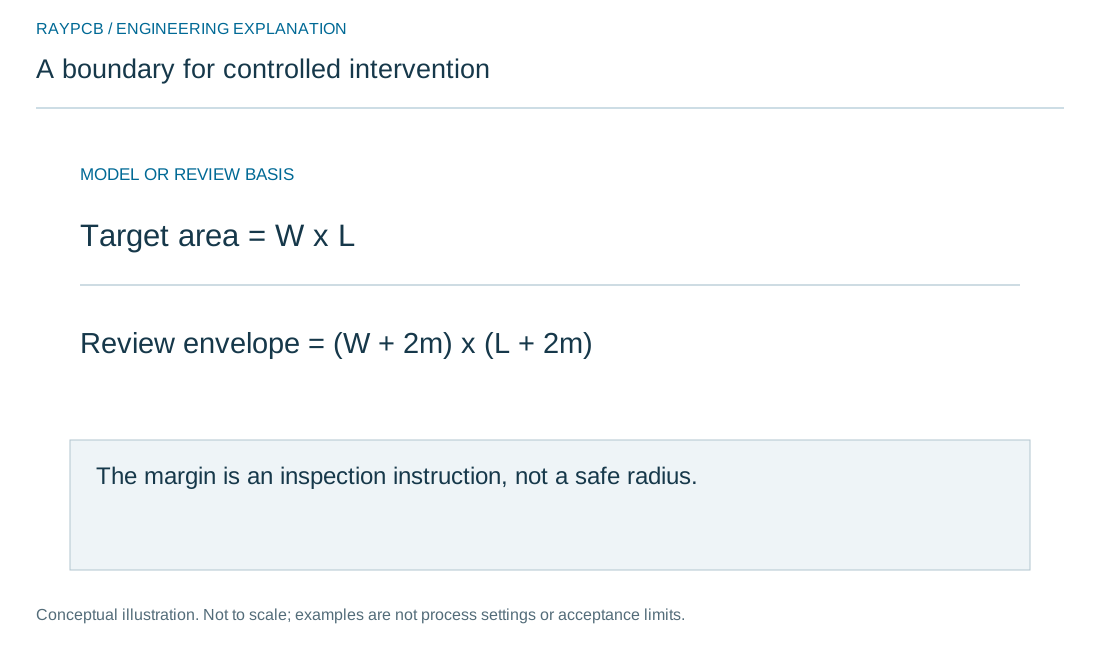
Removal and inspection envelope
Removal and inspection envelope
Use the current inputs and keep the assumptions
Start with the feature or process question you actually need to resolve. Fields are blank until you enter values or deliberately load an illustrative example. Example mode remains labeled after editing, so a sample is not silently presented as verified project data. Clear the example before preparing a project-specific record.
Use the units printed beside each input. Keep the drawing revision, measurement basis and source of any allowance in your controlled project records. A field that asks for a limit expects your agreed requirement; the example is not an IPC threshold or a statement of RAYPCB capability. A numerical result should lead to a focused review, not replace it.
Changing any input invalidates the displayed result and disables its download until you calculate again. The text download contains the current inputs, results and assumptions. Nothing is uploaded, stored in analytics or automatically transferred into the Contact form. You may attach the file manually if it helps explain your enquiry; completing the worksheet is optional.
| Input | What to establish before using it |
|---|---|
| Review reference | Use a nonconfidential reference to connect this worksheet to the correct design or process revision. |
| Target width · mm | Approved removal boundary, not an automatically safe rework area. |
| Target length · mm | The ideal target is rectangular. |
| Inspection margin on each side · mm | An entered review envelope, not a predicted thermal or chemical damage radius. |
Define success before touching the board
Acceptance can include the intended exposure, preservation of copper geometry, absence of unwanted conductive debris and the required condition of adjacent coating. Electrical checks may be needed for the affected network, but continuity alone does not establish that conductor cross-section or insulation has been preserved.
Photograph or otherwise document the original region at useful magnification. Retain the controlled instruction, operator or process record and post-work evidence. If a repair is experimental, identify it as such and agree the evaluation required before the assembly returns to service or further production.
Stop when the evidence changes
Unexpected copper lift, laminate exposure, cracking or component damage should trigger review rather than more aggressive removal. The original work boundary may no longer describe the condition. Reassess the disposition and whether a repair remains technically and commercially justified.
If the problem was caused by a design omission, consider a controlled CAD change for future builds instead of repeating manual removal indefinitely. A deliberate test land or corrected opening can remove recurring labor and reduce variation. Use opening design to define that permanent correction.
Request a rework feasibility review
Provide clear region images, the relevant layer data, board and assembly revision, purpose of removal and any restrictions on heat, chemicals or mechanical access. State the quantity and whether the board is a prototype, a production assembly or a failure-analysis sample.
The useful output is a controlled route with an acceptance boundary, or a reason to replace or redesign the board. It is not an assurance that every coating can be removed without risk. A focused review helps avoid spending labor on an intervention that cannot preserve the required function or evidence.
If the objective is to keep a feature protected during a future operation, review temporary peelable masking before creating a recurring removal task. Designing the protection step correctly can avoid unnecessary intervention on the permanent coating.
Keep the repair boundary smaller than the uncertainty
Before authorizing an intervention, identify what must be preserved. This can include conductor geometry, an insulation function, a component, a mechanical interface or evidence needed for failure analysis. The work instruction should make those boundaries visible so the operator does not have to infer them from an overall board photograph.
A controlled rework route needs a defined starting condition and stop condition. If unexpected damage appears, the original instruction may no longer apply. The responsible engineer should reassess the disposition rather than allowing the operation to expand informally until the surface looks acceptable.
Choose verification that addresses the affected function. Visual inspection, continuity, insulation-related tests and dimensional checks answer different questions. The appropriate combination depends on the intervention and product requirements. A successful power-on check is not a universal substitute for evaluating local damage or a restored coating.
Record the location, method identity, material where applicable and resulting evidence. Keep those records with the board or lot so later service or analysis can distinguish the original construction from the repaired state. If the work is experimental, identify it as a trial rather than silently treating it as an approved production route.
Repeated rework should trigger a review of the source design or process. A deliberate test point, revised opening, better fixture or controlled handling change may remove the recurring need for intervention. Compare the total cost and uncertainty of repeated repair with a corrected next build. The goal is a functioning, traceable product, not simply the lowest immediate labor charge.
Standards, source context and limits
Use the official references for their stated scope and the applicable controlled document for contractual requirements. A public scope page, product description or application note is not a complete acceptance specification. Material-supplier guidance applies to the named material and process; it is not evidence that every option is available for this board.
Agree the document revision, construction, inspection method and any exceptions with the responsible engineering and quality teams. The explanatory drawings and worksheet examples on this page are original planning aids, not factory records, qualification results or compliance certificates.