RAYPCB · ENGINEERING GUIDE
Electronic Assembly Soldering: Manual and Automated Route Planning
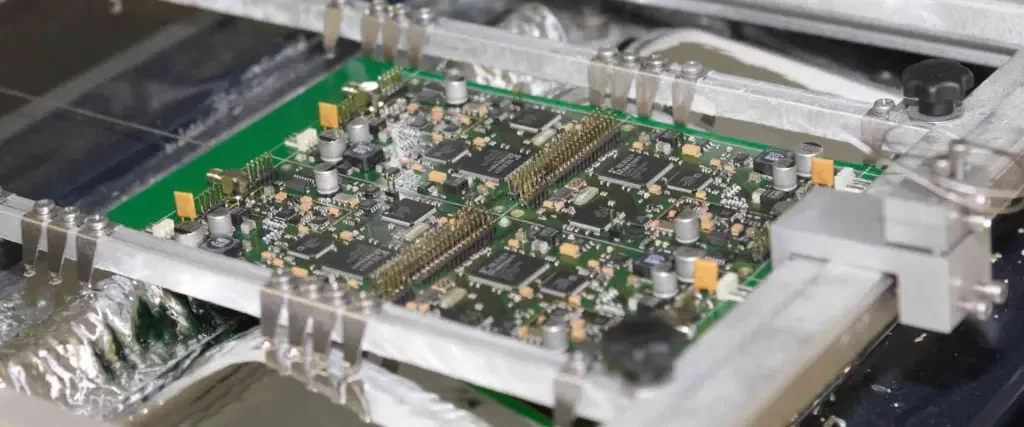
Electronic assembly soldering can combine manual, reflow, wave and selective operations within one build. The useful choice depends on which joints must be formed, access, product variation, thermal restrictions and the evidence needed to release the assembly. Automation is a production route, not a quality guarantee on its own.
This page is for teams comparing assembly proposals or deciding where a manual special operation belongs. The cost worksheet compares two routes using your own setup, cycle-time and hourly-cost assumptions. It contains no market rates and does not replace a quotation against the actual files.
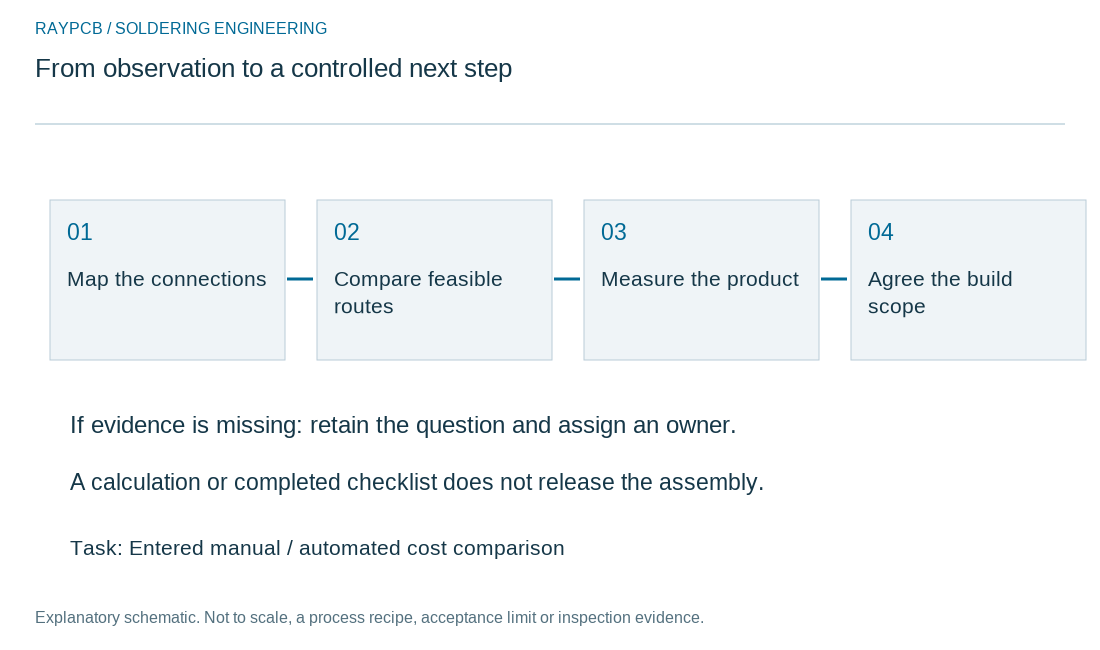
Map the joints before comparing equipment
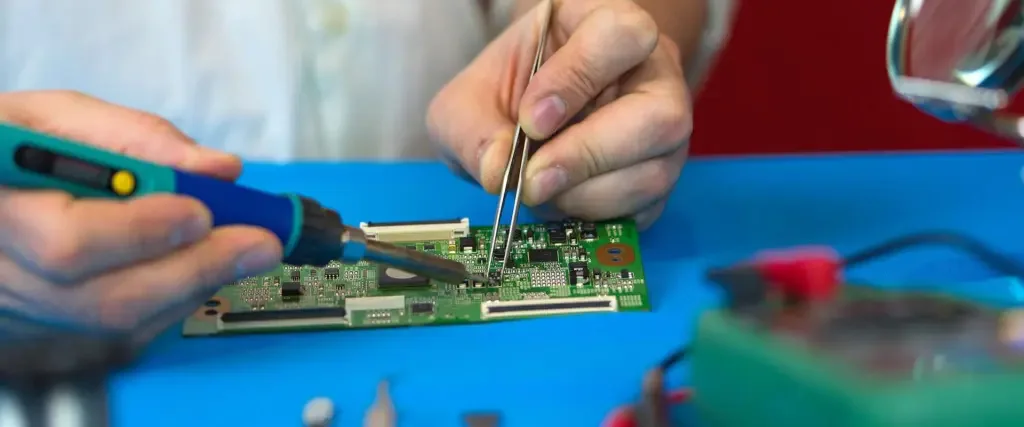
Separate surface-mount connections, plated-through-hole connections, wires, shields and mechanical attachments. Identify which operations can share a thermal step and which require local access or protection. A mixed assembly may need more than one route even when most components are surface-mounted.
The PCB soldering overview introduces the methods. Here the focus is the production decision: what work each route includes, what remains manual and how the completed result will be checked. Compare complete routes rather than a machine name against an operator's estimated seconds.
Define a comparable unit of work
State whether cycle time means one board, one panel or one selected group of joints. Include loading, fixturing, handling, verification and any necessary secondary operation when those differ between alternatives. Avoid counting a panel as one unit in one route and an individual board in the other.
Record the expected product mix and changeovers. A short recurring cycle can be outweighed by frequent setup on small lots; a manual route can become constrained by repeatability or staffing at larger volumes. These effects require actual process data rather than a universal volume cutoff.
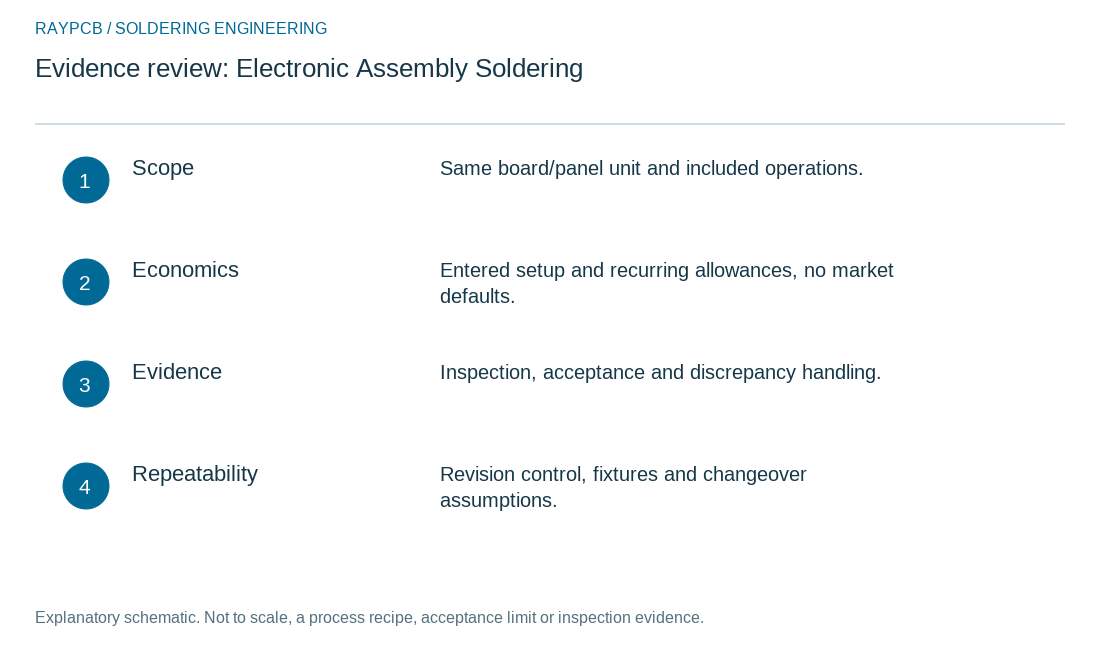
| Review item | What to establish |
|---|---|
| Scope | Same board/panel unit and included operations. |
| Economics | Entered setup and recurring allowances, no market defaults. |
| Evidence | Inspection, acceptance and discrepancy handling. |
| Repeatability | Revision control, fixtures and changeover assumptions. |
Entered manual / automated cost comparison
Entered manual / automated cost comparison
Use the current inputs and keep the assumptions
Choose the question you need to answer before entering numbers. Fields begin blank. Select Load example only to explore the model; example inputs are teaching values, not process recommendations or market prices. The example label remains visible after editing. Reset before preparing a record based entirely on your own data.
Use the displayed units and record the source of every input. Dimensions must share a reference and revision; temperature measurements must identify the location and method. An entered threshold or interval is your supplied review condition, not an IPC limit provided by this website. If a value is unknown, keep it open and obtain evidence rather than filling the space with a familiar number.
Read the assumptions alongside the result. A positive geometric margin answers only the stated calculation. It does not establish wetting, joint strength, production capability or compliance. A negative result remains visible so an incompatible assumption is not hidden. Checklist entries are self-reported and do not prove that the supporting documents were inspected.
Changing an input invalidates the displayed result and disables the download until the calculation is repeated. The text record includes inputs, results and limitations. Processing stays in this browser: no CAD data is read, no measurement system is connected and no information is automatically sent to Contact. Download and attach the record manually if it helps your enquiry. You can contact RAYPCB directly without using a tool.
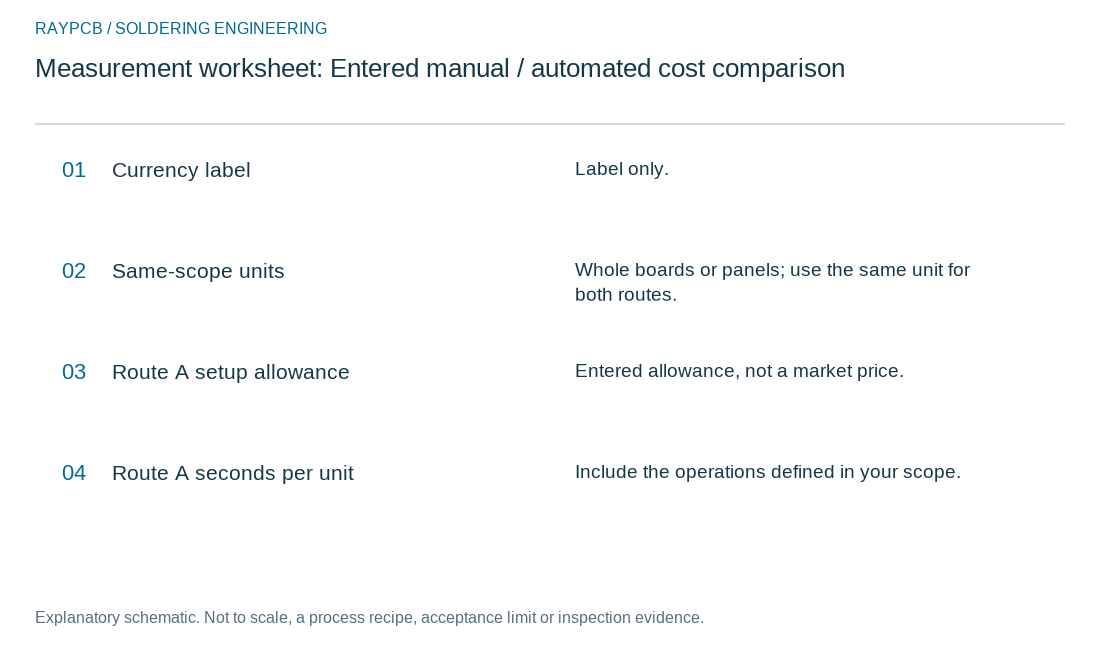
| Input | What to establish before using it |
|---|---|
| Review reference | Use a nonconfidential revision/reference. |
| Currency label | Label only. |
| Same-scope units | Whole boards or panels; use the same unit for both routes. |
| Route A setup allowance | Entered allowance, not a market price. |
| Route A seconds per unit | Include the operations defined in your scope. |
| Route A cost per hour | Your assumed or quoted rate; no hidden defaults. |
| Route B setup allowance | Do not duplicate setup in recurring rate. |
| Route B seconds per unit | Same included operations as A. |
| Route B cost per hour | Scope determines whether labor, machine and overhead are included. |
Separate setup from recurring allowances
Programming, fixtures, process development and first-build verification may be one-time or recurring by revision. Labor, machine time, consumables and inspection can be recurring. Decide where each item is represented so the same cost is not included in both an hourly rate and an additional allowance.
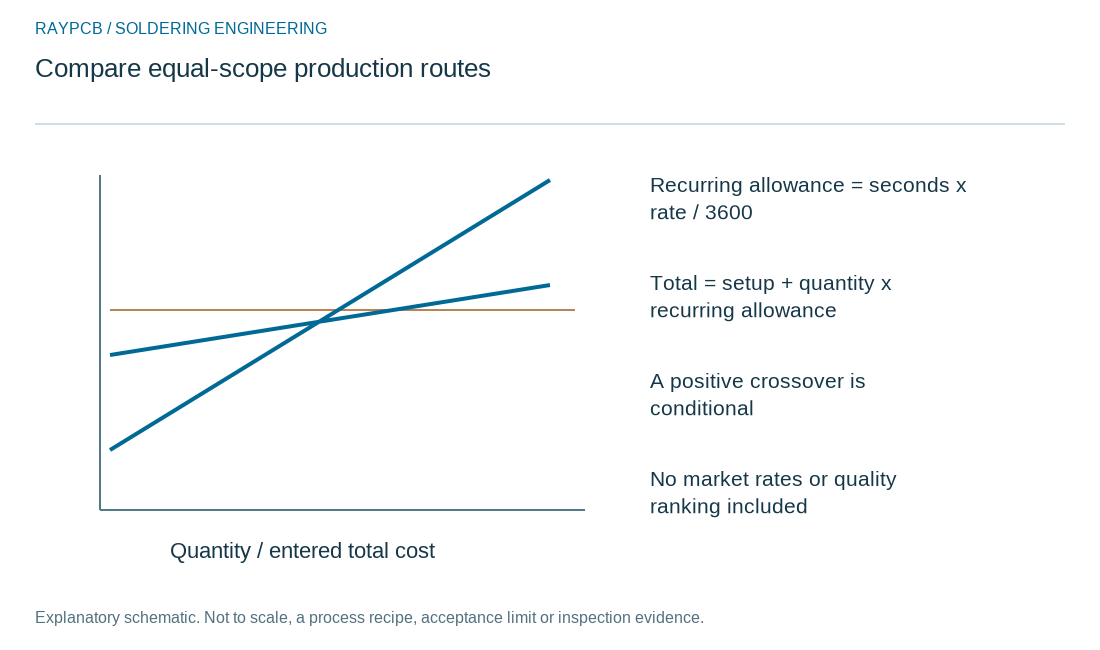
The worksheet uses a deliberately simple model: setup plus quantity multiplied by cycle seconds and an entered hourly rate divided by 3600. Treat the rate as the scope you define. If material, yield or logistics differ, compare them separately and explain why the simple model is incomplete.
Interpret the break-even quantity honestly
A mathematical crossover exists only under particular setup and recurring-cost relationships. If two recurring costs are equal, there is no finite crossover unless the routes are identical in this model. If the crossover quantity is negative, one route remains less costly for positive quantities under the entered assumptions.
For a hypothetical route A with higher setup and lower recurring cost, the positive crossover indicates where those entered lines meet. It does not prove that route A can produce the required quality or capacity. Check feasibility before using the calculation in a purchasing decision.
Include evidence and rework consequences
An assembly proposal should identify inspection coverage, acceptance basis and how discrepancies are handled. Visible joints and hidden interfaces require different evidence. A low quoted conversion price can omit inspection, cleaning or repair scope that another proposal includes.
For hidden arrays, use the BGA quality-control page. For local correction, the BGA rework route makes removal, site preparation and verification visible. These links support a complete build discussion without implying that every board needs every available test.
Control changes across repeat builds
Keep the assembly revision, BOM, variant, approved substitutions and process exceptions aligned. A route qualified on one component mix may need review after a connector, finish, paste or thermal-mass change. Repeated purchase orders should reference the controlled package rather than an informal description of the previous job.
Ask which changes trigger a new setup, profile or first-build review. This is especially useful for products with frequent engineering revisions. The most useful supplier response explains how the change is evaluated and recorded, rather than promising that automation makes revisions irrelevant.
Send a route-comparison enquiry
Provide the current fabrication and assembly files, quantity scenarios, expected repeat demand, customer-supplied parts and fixed process requirements. If a manual operation is causing cost or quality concern, identify the exact joints and the observed problem. Include the proposed inspection scope when it is already defined.
The PCB assembly hub is the next step for a build proposal. Attach the worksheet manually if it helps explain assumptions. You can ask for an engineering review without completing a calculator or disclosing a confidential internal rate in the website tool.
Build a route decision that a supplier can review
Start with a representative assembly and mark the connections that drive the process. Include the parts that are awkward to heat, inaccessible to a tool, sensitive to temperature or dependent on a special fixture. A route selected for the easy majority of joints may still leave an important secondary operation unresolved.
Make a short operation map: incoming condition, preparation, joining, cleaning if required, inspection and the next assembly step. The map should reveal what one route includes and what another leaves out. It is especially useful when comparing a mostly automated proposal with a manual operation, because their quoted cycle times may cover different work.
Separate fixed constraints from variables. The approved component, product safety requirement or enclosure interface may be fixed. The joining sequence, fixture, material candidate or inspection arrangement may be open to review. State who can authorize a change and which outputs need revision if it is accepted.
Choose a trial question that can be answered with evidence. Examples include whether an obstructed region receives the required heat or whether a proposed sequence preserves an already formed joint. Establish the measurement location, comparison method and acceptance basis before the trial. A successful demonstration on one accessible joint does not qualify the entire assembly.
When comparing cost, retain the same quantity, unit of work and verification scope. Separate setup from recurring allowances and identify what is excluded. Do not treat a lower arithmetic result as a reason to bypass a technical restriction. Where actual rates are unavailable, the honest outcome is a set of cost drivers and questions for the quotation.
For a repeat build, retain the approved route and the conditions that make it applicable. A material or component change can invalidate an earlier assumption even if the PCB outline is unchanged. The enquiry should therefore include the current revision and differences from the previous build, rather than relying on the phrase same as last time.
Standards, source context and limits
Use the references for their stated purpose. A material-vendor application note supports its specified material and conditions; a research paper reports the study it describes. Neither should be converted into a universal setting or a guarantee for a different assembly. Public standard summaries and contents are not complete normative requirements.
Agree the applicable controlled documents, revisions, acceptance basis and exceptions before production. IPC J-STD-001 concerns requirements for soldered assemblies, IPC-A-610 addresses assembly acceptability, and IPC-7711/7721 addresses rework, modification and repair procedures within its scope. Applicability must be established for the contract and task; this page does not certify compliance or reproduce paid acceptance tables.
The photographs are selected from the existing RAYPCB website archive and illustrate relevant materials or operations. They do not establish current equipment ownership, certification or completion of your project. Original diagrams explain concepts and measurement boundaries; they are not inspection evidence or released manufacturing drawings.